Thread Memory: Embroidery from Palestine is made in partnership with Art Jameel, the Palestinian Museum, V&A South Kensington and V&A Dundee. It is based on an exhibition of the same title that was exhibited at Hayy Jameel.
Thread Memory: Embroidery from Palestine
curated by rachel dedman for victoria & Albert museum
Read Wafa’s article "Holding On and Losing Hold: Reflections on Thread Memory,” published by the Victoria & Albert Museum Dundee Supporter Magazine, Winter 2025, Issue 2 [Download PDF]
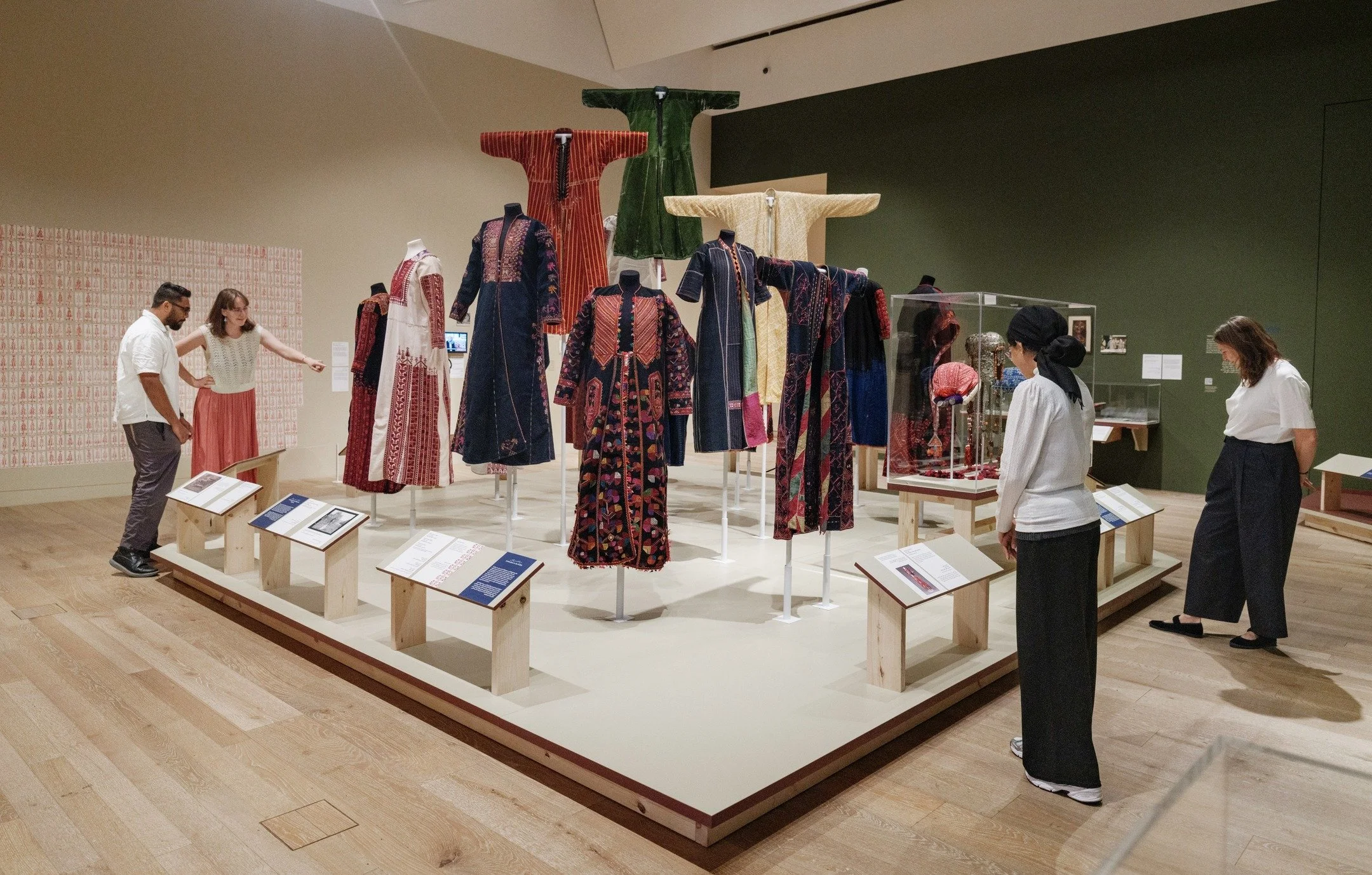
Thread Memory: Embroidery from Palestine at the V&A Dundee examines the historical, cultural, and political dimensions of tatreez, the traditional hand-embroidery of Palestine. The exhibition presents tatreez as an expressive language shaped by regional styles, gendered social histories, and the interrelation of art, identity, and resistance. It brings together traditional embroidered dresses that bear motifs, cuts, colors, and stitches recording a woman’s milestones, social status, and transformations in Palestinian rural and urban life. The exhibition also underscores the historic twinning relationship between Nablus and Dundee, drawing upon material from Dundee’s collections as well as Palestinian sources to articulate a story of cultural connection and shared history.
I was commissioned by V&A Dundee as a contributing designer to produce a suite of components in support of this exhibition. My responsibilities included the Common Threads Community Project, which brought together members of the Dundee community to learn and study Palestinian embroidery and their connections to Scottish culture. My work also included the development of interpretive materials and interactive resources that deepen public engagement with tatreez and the material on display to foster reflection on its role in heritage, resistance, and identity, and expand access for diverse audiences across ages. My work, in collaboration with Cara Rooney and Skye Sutherland, contributed to the exhibition’s educational framework by creating resources that extend beyond the museum into libraries and community settings.
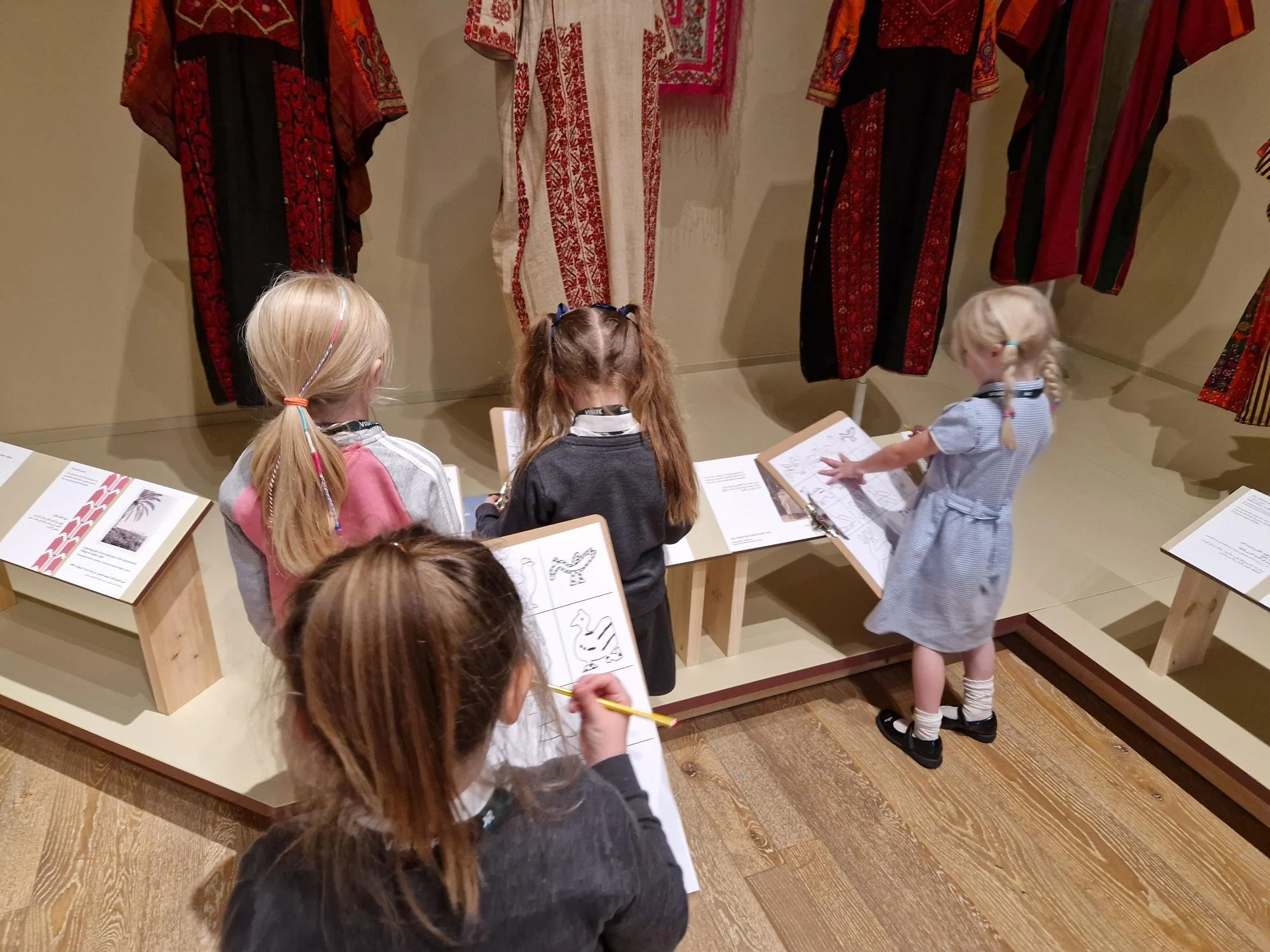
School children learning about Palestinian dress in the galleries of "Thread Memory” at V&A Dundee.
Thread Memory Activity Sheets
I collaborated with Scottish illustrator Cara Rooney to create a series of activity sheets for the Thread Memory exhibition. These resources introduce tatreez, the thobe, and the art of close-looking as I once learned from my mother as a young girl. It was an honor to work with Cara to develop ideas that could engage a wide range of age groups. The activities invite participants to explore tatreez motifs, thobe decoration, the twinning of Nablus and Dundee, and playful landscapes that honor Palestinian people and culture. Our aim was to create materials that spark conversations about Palestine in many different ways and open up pathways for learning and cultural preservation. The sheets will be used inside the museum and in community spaces, including local libraries in Dundee. This ensures that the resources reach audiences beyond the exhibition walls and continue to inspire reflection and dialogue.
About Cara Rooney, illustrator from Dundee, Scotland: She encourages playful connections to the world through interactive books, activity resources and creative workshops. By combining bright colors, bold compositions and handmade textures, Cara creates illustrations with a sense of child-like wonder. Through all of her work, she aims to inspire a sense of curiosity for the world, and empathy for the creatures and people we share it with. Learn more about her work here.
Activity Sheets Educator’s Guide: Original Inspiration & Desired Learning Outcomes
Cara and I have worked so thoughtfully and carefully in creating these activity sheets, we want to share our intentions, inspirations, and desired learning outcomes to help you guide your classroom or group in utilizing them. I worked on a number of designs in the exhibition, including these activity sheets, and one central theme is the bird motif. How many birds can participants find in their sheets? What are they doing and where are they going? What do birds symbolize in global culture, and in your culture?
Stitching Stories
Stitching Stories celebrates the twinning of Dundee and Nablus, and inspires participants to create patterns to show solidarity between the cities. The design features a top section made up of illustrations of both cities, twin doves and a sea connecting the two lands.
The bottom section is made up of repeated patterns developed during the Common Threads Community Project. The project made use of tradititional Tatreez motifs, combining and repeating the designs to create new patterns showing solidarity with Palestine. Cara and I wanted to create a space where participants could create cross-stitch patterns, while also acknowledging the importance of Palestinian embroidery motifs as a separate, sacred space.
Tatreez as a Language
Tatreez as a Language looks at Palestinian embroidery motifs as methods to communicate life, land, ideas, and experiences of the Palestinian people. Tatreez is an interpretative language, that reflects the intangible cultural heritage practices of Palestine. The art of embroidery in Palestine — the practices, skills, knowledge, and rituals — were inscribed in 2021 by UNESCO on the Representative List of Intangible Cultural Heritage. This inscription matters because it provides global recognition for traditions with “outstanding universal value,” thus enhancing their protection, and raises awareness among citizens and governments for heritage preservation.
After learning about the meanings of four different tatreez motifs, audiences are invited to design their own patterns to symbolize something in their life.
The design features drawings of the mentioned motifs, and a grid base to assist in the creation of their own pattern. In order to be sensitive to preserving Palestinian culture, participants are invited to create a ‘pattern’, to maintain the distinction between these creations and authentic embroidery motifs that are traditional to the Palestinian people.
Love of Land
Love of Land encourages audiences to design a peaceful landscape of birds, trees, and flowers for the children of Palestine. This design was inspired by the story of an embroidered child’s dress that survived the bombing of the Rafah Museum in Gaza on October 28, 2023, and is exhibited within V&A Dundee as part of Thread Memory. Cara and I wondered, what would the fate of this dress be had the child lived in peace?
The design features a selection of nature themed Tatreez motifs along the bottom of the sheet, as inspiration to help populate the landscape. It also features a quote from a Gaza folk song - “I wish I was like you, dove, I wish I could fly like you”. Palestinians have a love for land so great, that they reflected patterns of nature and animals in their dress, and on their bodies.
Although not explicitly stating the current genocide in Gaza, the sheet aims to act as a starting point for conversations about people of Gaza currently being unable to live in peace. The child’s dress was heroically rescued with two other adult women’s embroidered dresses. The two other dresses are featured in this illustration, as well.
Decorate a Dress
Decorate a Dress encourages participants to explore Thread Memory, and take inspiration from the marks, motifs, shapes, and colors before decorating their own thobe for themselves or someone they love.
The designs can be created using any methods they would like, as is an opportunity to look more widely at the layout of a thobe and how the tatreez designs are typically applied. This activity is useful to understand the various parts of a dress, and what makes Palestinian dress unique.
Take a Wander
Take a Wander is inspired by the various birds, animals and creatures found on the Palestinian dresses in the Thread Memory exhibition.
The sheet can be used as a coloring sheet, or as a trail to find the different animals in the museum. Outside of the context of the exhibition, one can observe all of the different ways birds and animals are depicted across Palestinian dress; not only from village to village, but dress to dress! Each woman had her own perspective and creative approach to stitching animals.
Story of the Thobe
Story of the Thobe encourages participants to act as a researcher or historian, looking closely at a thobe in the Thread Memory exhibition. They are instructed to look for details, fabric type, embroidered details and the colors used.
Using this information, and looking for evidence of wear, the participant imagines who wore the dress and what might have happened while they wore it.
The task remains open to interpretation, and could be a starting point for conversation about what daily life might look like in Gaza, or be used for a fully imagined story. The output can be created using story, drawings, storyboarding or simply notes.
Finding Connections
Finding Connections aims to link participants with Palestine through elements of nature we all experience.
Inspired by the Hawthorn plant, participants are prompted to draw or write about their favourite flower. Inspired by the star or moon motif, they are invited to look at shapes we share in our sky. Looking at the Cypress tree, participants are encouraged to draw and think about trees nearby, and inspired by the dove, prompted to look at birds flying in our sky.
Each area is surrounded by borders of drawings inspired by tatreez motifs.