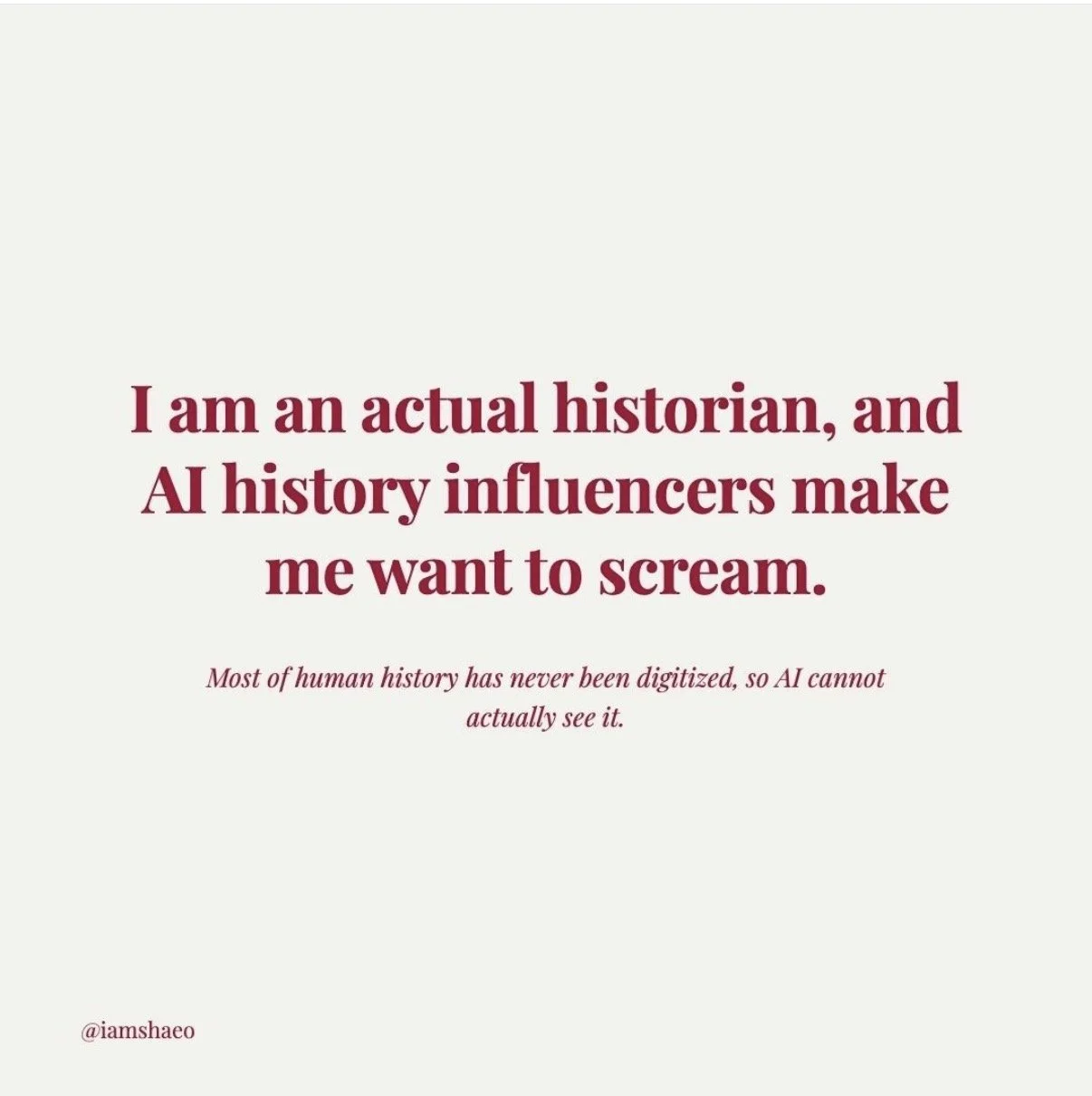
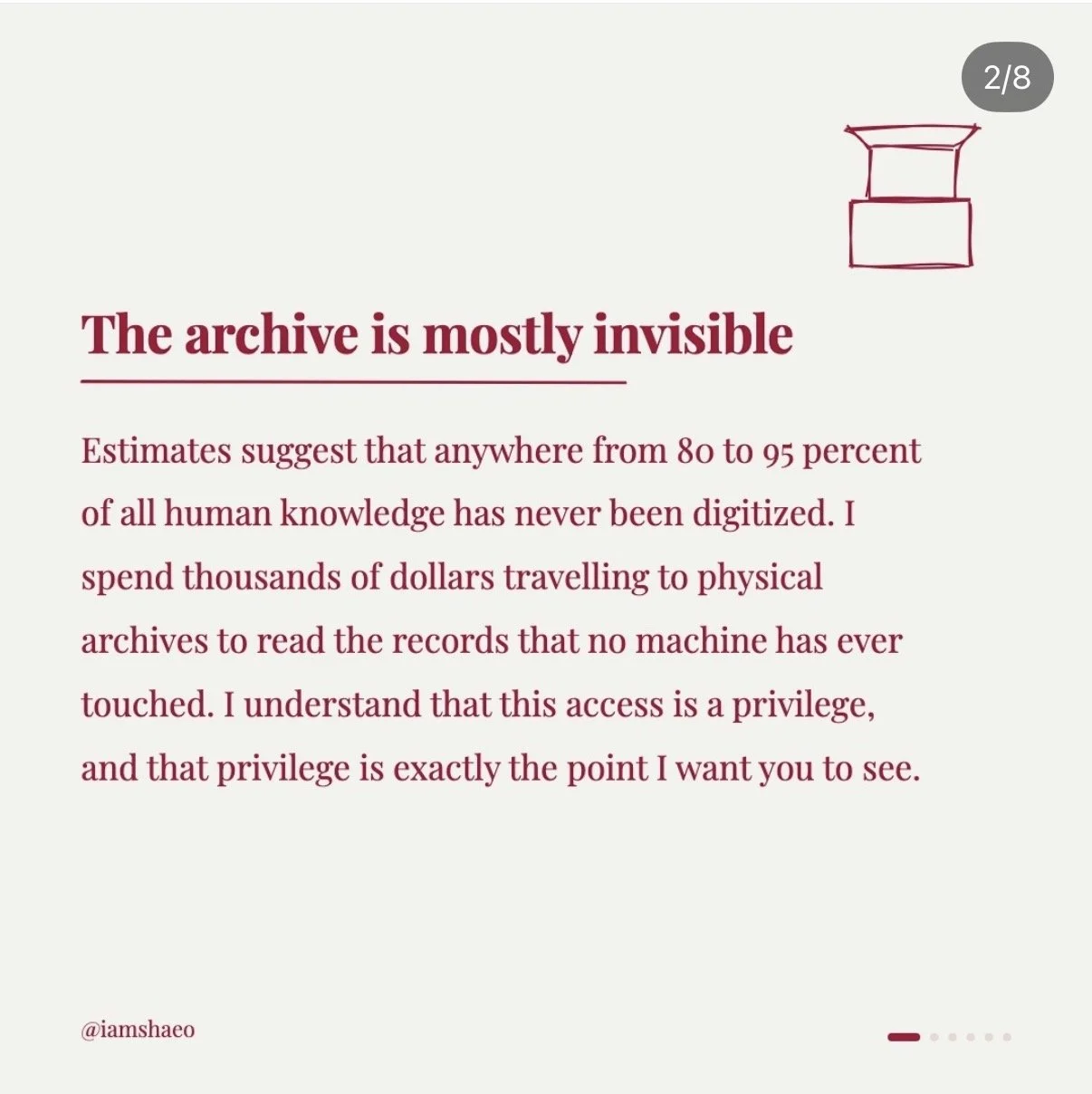
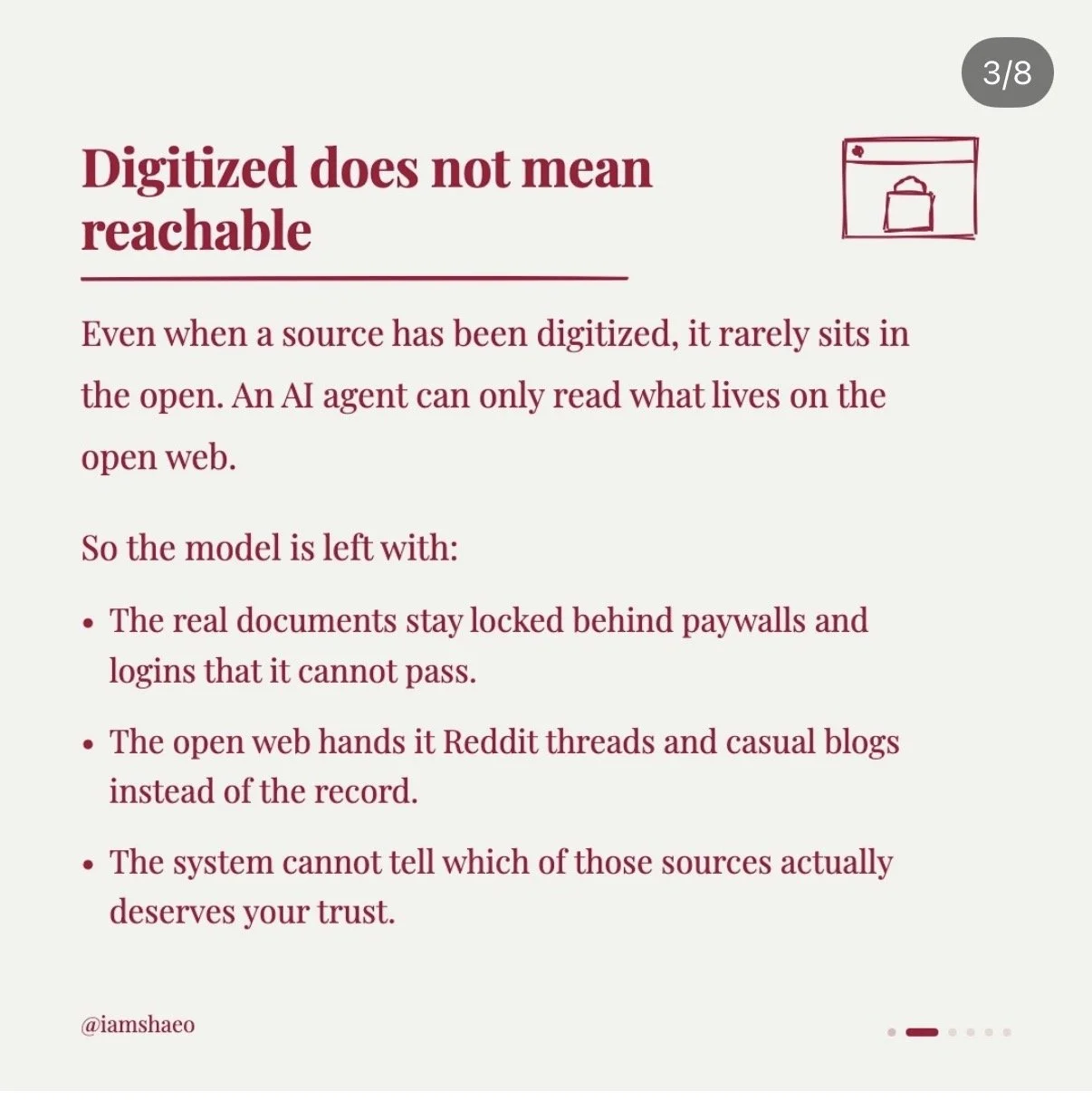
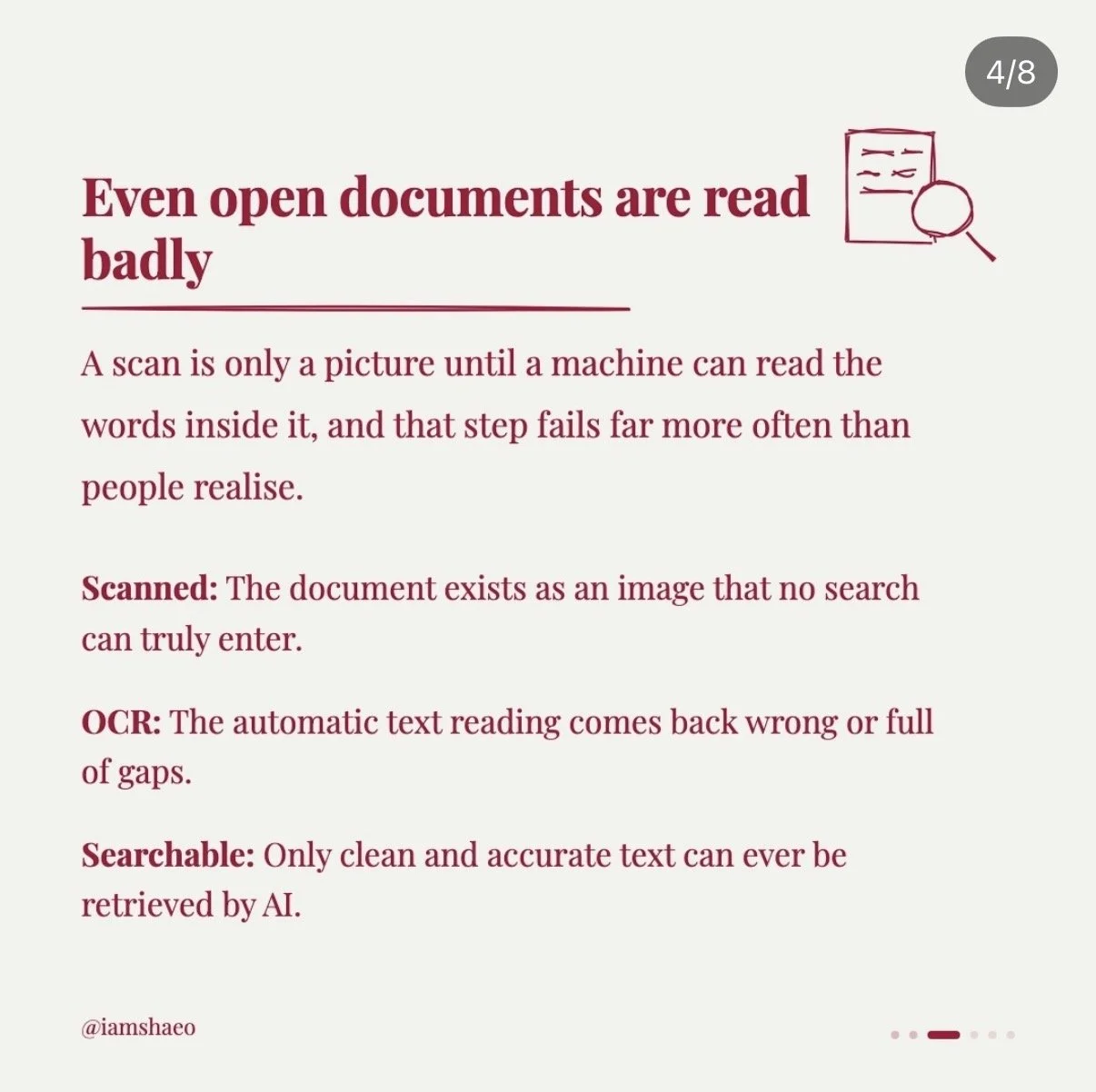
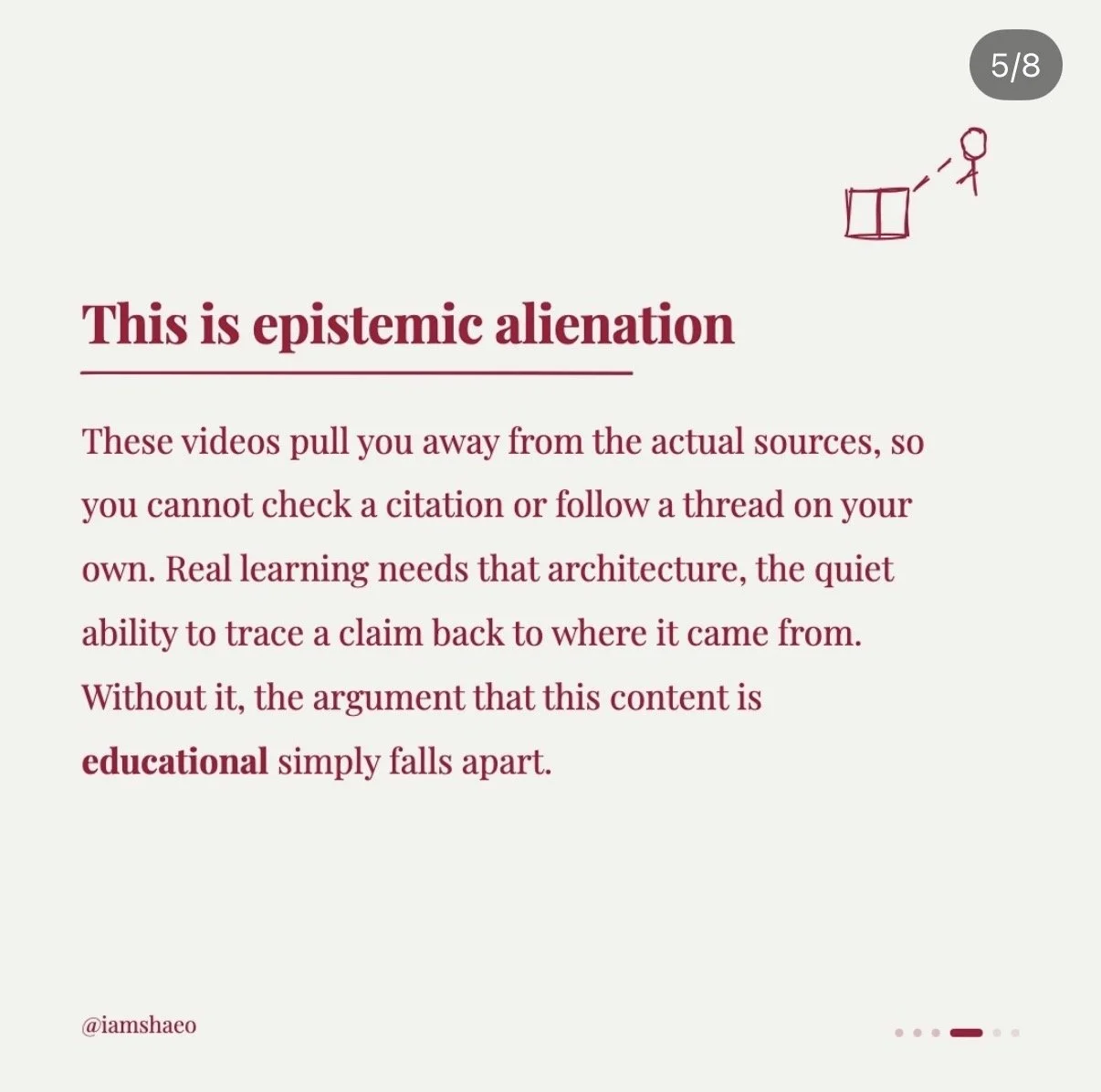
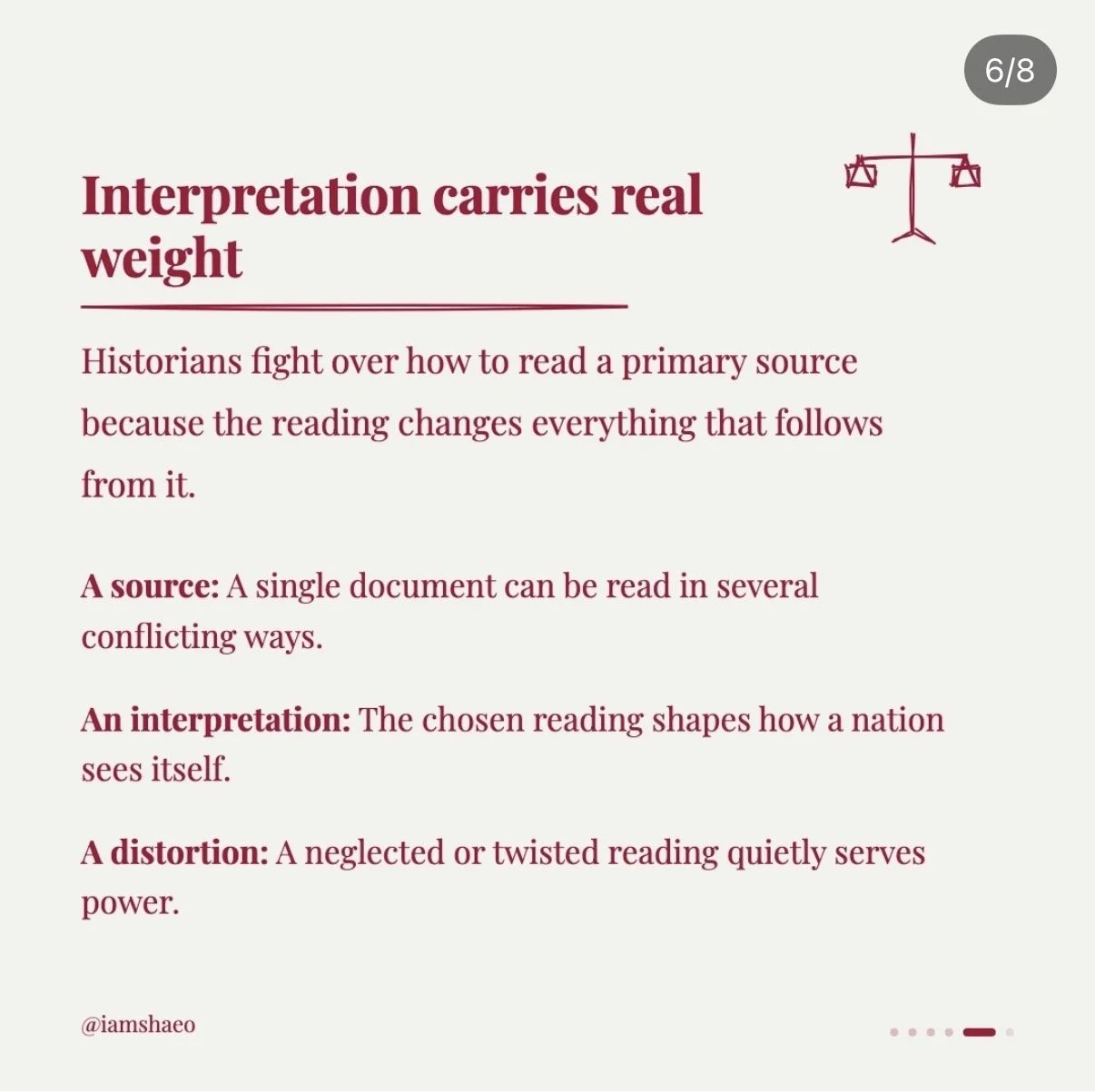
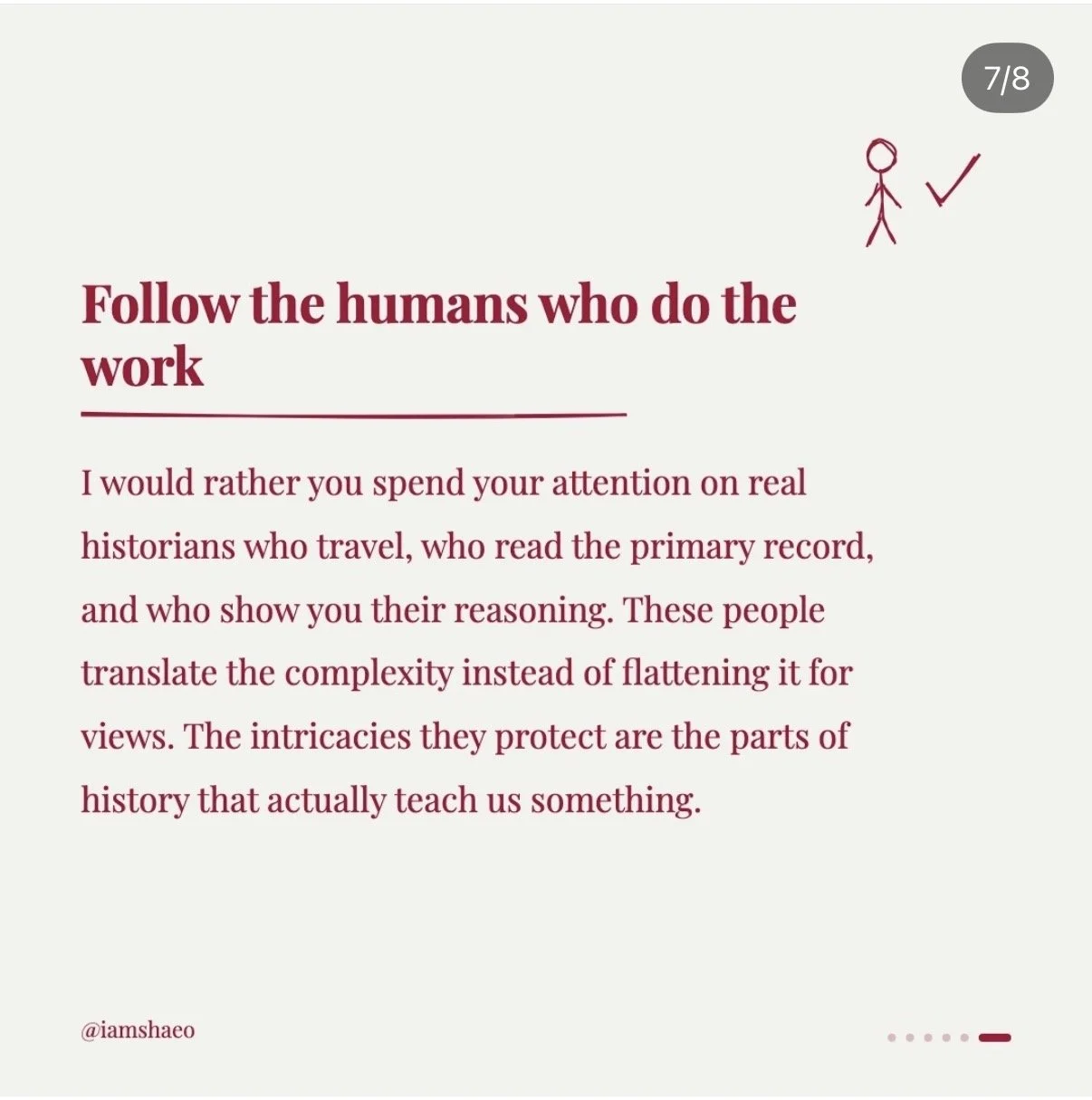
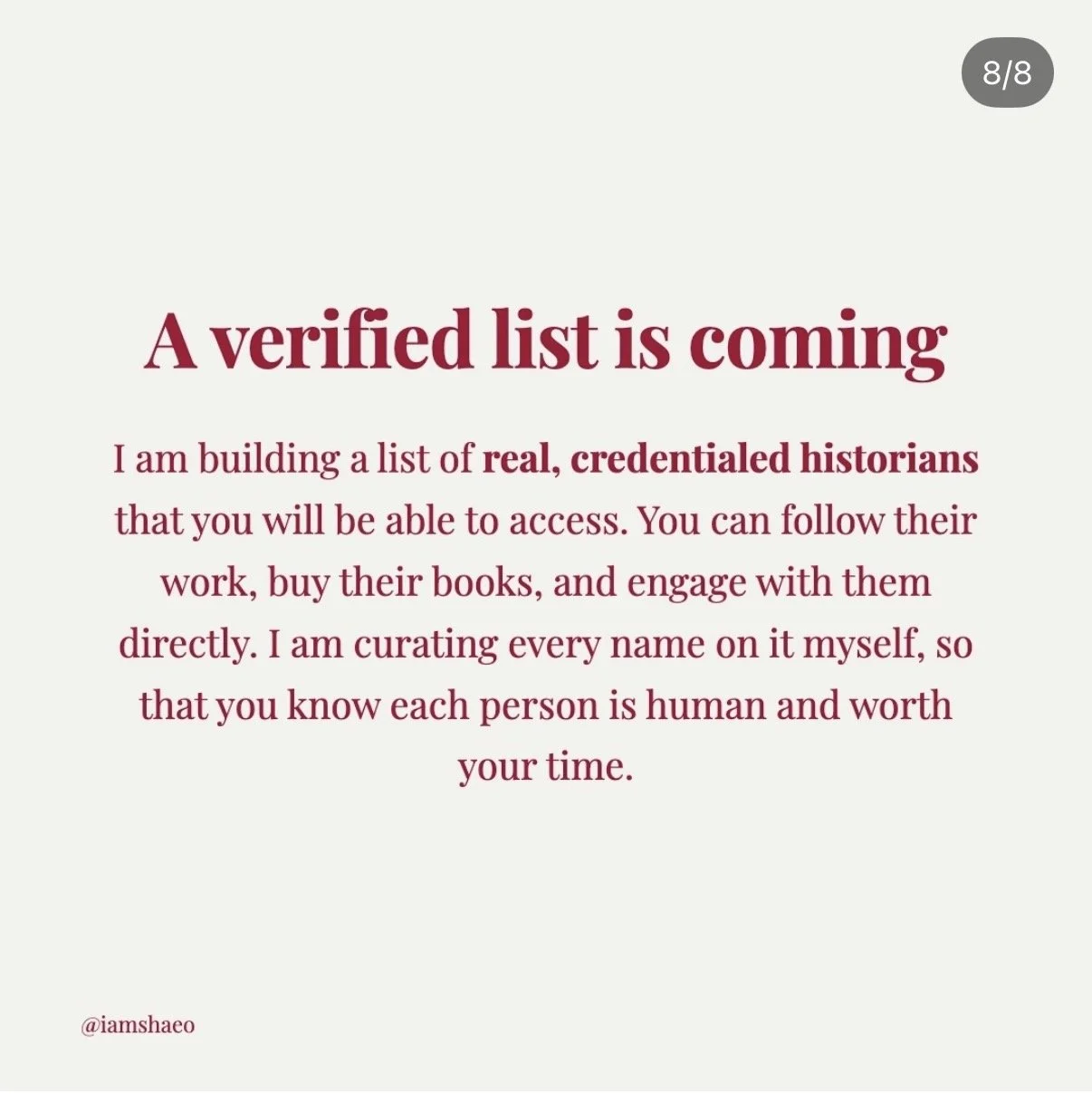
Yesterday, my dear friend and lace historian Elena Kanagy-Loux shared the above post by Shae O. Omonijo, who wrote about the frustrations of being a historian in the age of “AI history influencers.” Shae’s post encapsulates so many of my recent experiences, and this topic has weighed heavily on me this past year. The use of AI is surging, especially on social media, in heritage spaces and in the art world.
The increase in Palestinian arts and culture AI content online has gone from reflecting a resurgence of the craft, to a uniformity of posts that read largely the same — phrases like “quiet resilience,” “a living archive,” and “every stitch carries a memory” are repeated everywhere ad nauseam. Some argue that people, cultures, and nations use similar terminologies and phrases when large cultural events or historic moments occur. However in this new chapter of AI, such homogeneity in phrases and terms to discuss historical facts, not pop culture moments, reflects a shallow understanding of heritage — as well as an art form that is endangered and lost; not protected and revived.
As a way to survey the extent of AI use in heritage spaces, I’ve attempted to engage in critical discussions that have been met with a great deal of defensiveness and emotion. It seems that if someone chooses to use AI to generate their work, they should be able to engage in critical discussion as to why and how. Unfortunately, I’ve been met with such a severe lack of engagement that I am more skeptical than ever.
AI has a massive and rapidly growing environmental footprint — demanding extraordinary volumes of energy and water required to power global data centers — it has also significantly powered the genocide in Gaza. AI has both accelerated Israel’s killing of Palestinians and created a “mass assassination factory” of automated warfare in Gaza and the West Bank. AI is used to detect “targets,” select and recommend “targets,” and kill without mercy. More than 50,000 children have been injured or killed in Gaza at the hands of Israeli genocidal violence since October 7, 2023.
Why would we — Palestinians — volunteer our heritage images, traditional knowledge, and indigenous practices to AI? Why are we entering our thoughts, our ideas, our humanity, our names and identities, into a system that consolidates that information into forms of surveilance and warfare that is directly targeted… at us? AI systems, cloud infrastructures, and surveillance tools supplied by ChatGPT, Claude, Google, Amazon, Microsoft, and Palantir have become integral to Israel’s genocidal campaign against Palestinians.
I urge all those who work in Palestinian cultural heritage, embroidery, dress, museums, etc. to read my statement below, reconsider their relationship with AI, and draw boundaries in their use of this tool. My statement below is not robust, nor exhaustive — however, it does start a conversation. Misinformation is rampant on social media — I see videos of Palestinian influencers, designers, and tatreez businesses who, in totality, generate scripts, captions, and incorrect historical summaries (as well as offensively incorrect symbolism interpretation of tatreez motifs) on a daily basis. This is AI slop. Palestinian embroidery is not a business, it is heritage. If you sell kits, produce content online, or offer classes — that’s great, but Palestinian embroidery, unlike a purely capitalist venture, requires protection. Capitalism on its own is morally bankrupt.
The truth is that the vast majority of people, especially the younger generations, can immediately detect AI slop. Lying about AI use, which is also on the rise, causes loss of trust, rejection of work, and accusations of plagiarism. My work, which is primarily published online, is heavily plagiarized in tatreez content on social media and online. There are also significant issues with misinformation of Palestinian embroidery and dress history causing not just the community, but museums, to publish incorrect information in their exhibition materials. AI slop is harmful and causes cultural erasure.
If you are deeply committed to using AI for some purpose that you feel is justified, the next best thing you can do is to be transparent with your use of the tool — and at minimum, make a great effort to protect the images, identities, names, and oral histories of not only Palestinians, but of all peoples.
In love and solidarity,
Wafa
Artificial Intelligence (AI) Disclosure
All research, analysis, interpretations, written content, lecture materials, and conclusions presented in the website, lectures, and publications were developed by Wafa Ghnaim without the use of generative artificial intelligence tools. Sources were discovered, read, reviewed, and interpreted directly by Wafa through her own independent research methods. This work is the result of years of research, fundraising, grant writing and stewardship, travel, fieldwork, archival visits, and conversations with elders, historians, artists, and community members. Wafa has fundraised and managed grant funds and donations in order to pursue this research, visit archives that have not been digitized, document collections in person, and record oral histories and traditional knowledge that might otherwise be lost and erased.
Wafa believes that heritage images, oral histories, traditional knowledge, and cultural materials are sacred responsibilities that require protection. For this reason, she does not feed such materials into generative AI systems and opposes the extraction, reproduction, and repurposing of cultural heritage through these technologies. Readers are encouraged to consider these ethical questions critically in their own learning, interpretation, research, and creative work.
Any errors, omissions, or interpretations remain solely the responsibility of Wafa. All theories presented are based on her understanding and interpretation of the knowledge she has gathered over years of study and community engagement. Citations have been provided wherever possible. Not all Palestinian dress historians interpret the material the same way, and it is important to present Wafa’s work as reflective of her theories and synthesis of the materials. Some of her ideas are not universal concepts.
It is also important to note that if any AI-generated content is detected in connection with this website or Wafa’s work, it is not reflective of the research, writing, or interpretive process she pursues in her work. Wafa does not use generative AI tools in the development of her scholarship, lectures, or written materials. Any use of digital tools that may incorporate AI is limited to search engines, translation, or online thesaurus use, which are part of general writing and research practice and not used to generate analysis, writing, interpretation, or content.
If you leverage Wafa’s research in your publications, social media, artworks, educational materials, content production, or other projects, please cite your sources, provide proper attribution, and honor the communities and knowledge keepers whose histories, and ongoing committment to cultural heritage protection, made and make this work possible.